Step inside La Pedrera, UNESCO World Heritage Site and one of Barcelona’s most iconic buildings, to explore how engineering and sound come together. In this project, you’ll explore different rooms designed by Gaudí to find out which one sounds best. Using scientific equipment and the cutting-edge technological infrastructure of the IASlab, you’ll learn how acoustics and audio signals work —and then put that knowledge into action as you measure and record how sound travels through each space. You’ll experiment with sound, music, architecture, and immersive audiovisual tools to explore how design changes what we hear —and reveal which room has the best acoustics (the answer might surprise you!).
You’ll work like an acoustic engineer—planning a measurement campaign, operating sound level meters, a dodecahedral (omnidirectional) sound source, and microphones; processing impulse responses; and turning data into engineering decisions that improve speech intelligibility, musical clarity, acoustic comfort, and visitor experience.
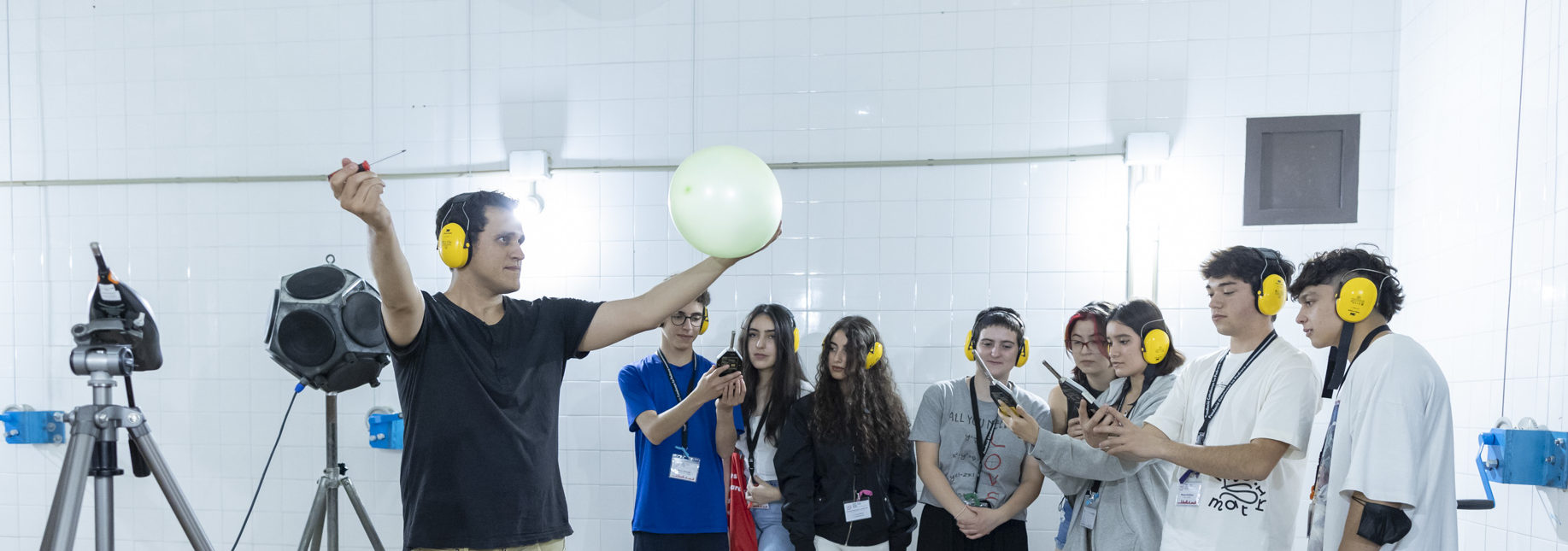
In week one, you’ll build core skills in acoustics and audio signal processing through practical sessions in the anechoic chamber, reverberation chamber, and audio recording studio. You’ll produce technical drawings from measured data and create annotated 3D models in SketchUp to prepare for your on-site measurement campaign at La Pedrera.
In week two, you’ll return to the lab to analyze your recordings and determine which spaces perform best acoustically. Using auralization — combining anechoic recordings with measured impulse responses — you’ll recreate how each environment actually sounds. You’ll then prototype immersive experiences that capture the acoustic character of each area, revealing how Gaudí’s geometry shapes sound.
Why this project? Because it blends rigorous acoustic engineering with a world‑class heritage site, giving you authentic field data, modern analysis workflows, and a clear line‑of‑sight from measurement → model → human perception → design.
Learning objectives
By the end of the project you will be able to:
- Create precise, scaled technical drawings using CAD software.
- Design and execute an indoor acoustic measurement protocol in a real building.
- Compute and interpret room acoustic parameters such as reverberation time, musical clarity and speech definition.
- Relate metrics to perception for music and speech (reverberation, musical clarity and speech definition).
- Use multi‑criteria decision making to select the most suitable room and defend the choice with evidence.
- Communicate results with clear visuals, audio examples, and an engineering brief for non‑experts.
Matching profiles
Great fit if you are curious about Acoustics, Audio Engineering, Audio Signal Processing, Physics, Telecommunications, Computer Science, Architecture, Design, or Digital Arts—and you love building things from real data.
Required materials
- Laptop with at least 8 GB RAM (16 GB recommended) and admin rights
- Headphones (closed‑back preferred)
- Notebook + USB drive
- Lab coat and safety glasses will be provided when needed
All professional acoustic equipment is provided: sound level meter, dodecahedral sound source + amplifier, monarual and ambisonic microphones, audio recorder, laser measure, tripods, and calibration tools.